The endgame in chessThe end game is the last phase of a chess game. This part of the game is characterized by a relatively small number of pieces on the chess board. The end game is the most analyzed part of the game. There is a huge volume of information about it, many chess books focusing specifically on this part of the game. The reason for this is that in end games certain patterns in positions appear to repeat themselves during games. That means that, because there are relatively few pieces on the board, a particular position may appear more than once in your games. Many beginners make the mistake of overlooking this part of the game as they believe it to lack any spontaneities. They believe that this phase of the game is only about calculating the possible moves. That is not true. Although it involves the cold, mathematical like, analysis of the game, the end game can also contain amazing tactical procedures and combinations. If you don't believe me just look at the grandmasters : they all exceed at this part of the game. Another argument in favor of studying more careful the end game is that in this part of the game, supposing you know how to play it, you could take benefit of even the smallest advantage you gained during the opening and middle game. Of course ,if you have a disadvantage you can sometimes end the game as a draw. For example if you reach to a point where on the chess board there are only your two bishops your king and your opponent's king do you think you can checkmate his king? If you are familiar with this kind of an end game you probably will. But if you aren't I'm almost sure that you won't be able to checkmate. And this is just a basic example of a chess end game. There are countless more end games that you need to know in order to really know how to play chess. This site has only a few basic end game examples for now. If you are really serious about wanting to learn the game I suggest you look for a good book that necessarily must contain more end games studies.
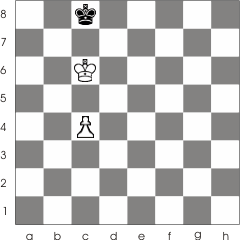
When establishing the square you should keep in mind that from the initial position the pawn can move two squares... so pay attention!
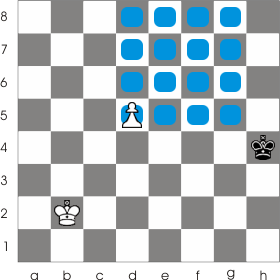
What is oppositionThe term of opposition refers to the position of the two kings placed one in front of the other separated by a square. Obtaining opposition is very important in pawns endings and in many cases is decisive. Look at the following game. Opposition 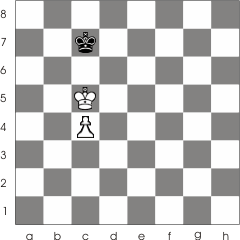
ZugzwangZugzwang is a situation that takes place when a player that has his turn to move is forced to make that move even if it will cause him a disadvantage. There are times when you can play in such a manner that you can bring your opponent in a zugzwang situation. What would happen if we were to add to the example from the previous article those pawns in the right? The absolute beginner could say that the position is equal because both sides have an equal number of pawns. That is far from truth. Notes that Black isn't able to move his pawn from h7 because the white pawn from g5 will immediately capture it (either by en passant if 1... h7-h5 or just a regular capture if 1... h7-h6). In fact White will win regardless of who moves first. If Black were to move first then he would loose the opposition and we would have the same situation from opposition. If White will make the first move then he will bring Black in a zugzwang position.
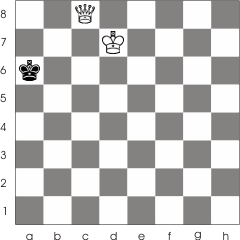
One queen checkmateIn order to checkmate the opposing king the queen needs the support of its own king. There is a certain plan you should follow when mating in simple positions. The plan is to gradually reduce the opponent's king free space. In our case you have to limit the king's movement on a line on the edge of the board. The queen will do this from distance while its king will gradually get closer. That is why the king which is about to be checkmated must stay as far as possible from the opposing king (the queen can't checkmate it on its own). You should also know that in this situation (king and queen against king) the checkmate will occur in at most 10 moves. There are certain stalemate positions that may appear in this kind of endgames. You should know what to do when you run into tem. For example look at the chess board below. 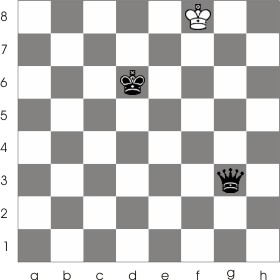 If Black were to move 1... Qg6, then he would provoke stalemate (the white king has nowhere to go). Wouldn't that be a shame.. if you are so close to victory and make a bad move like this...!The right move is : 1... Ke6 and now the white king is trapped in a zugzwang position : he has nowhere to go but 2. Ke8 Qg8
One rook checkmateJust like in the case of checkmating with one queen, the rook needs the support of the king in order to checkmate the opponent. It uses the same principle : the rook reduces the enemy king free space while its king approaches it. Look at the following example :
Two rooks checkmateIn the case of a king and two rooks against a king the stronger side is able to checkmate the opponent without the help of the king. But if the king steps in the checkmate could occur anywhere on the board. When mating only with the rooks the king is leaded towards an edge of the board by the two rooks. Just take a look at the example. When mating with the king's support, we have a similar situation to that of mating with one rook. In this case one of the rook takes the place of a chess board edge( So the king can't pass the squares controlled by this rook). This way it could be checkmated even on the middle of the board.
Two rooks checkmateIn the case of a king and two rooks against a king the stronger side is able to checkmate the opponent without the help of the king. But if the king steps in the checkmate could occur anywhere on the board. When mating only with the rooks the king is leaded towards an edge of the board by the two rooks. Just take a look at the example. When mating with the king's support, we have a similar situation to that of mating with one rook. In this case one of the rook takes the place of a chess board edge( So the king can't pass the squares controlled by this rook). This way it could be checkmated even on the middle of the board. This were just a few simple checkmating patterns that may occur in endgames. Now we are going to take a look at checkmating patterns that may occur somewhere else than the end game. This are quite often among beginners so by knowing them you will learn how to avoid them or how to apply them in your game.
Checkmating on the back rankAfter a player castle, he gets his king into a safer location. Look at the following example. 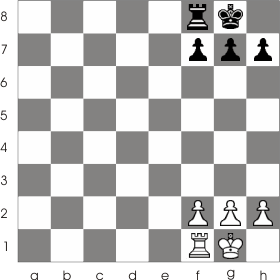 Both White and Black had performed the castling. But, if in this position, the king is attacked by a rook or the queen and the disadvantaged player has no possibility of capturing the attacking piece or has no possibility of interposing a piece between the king and that rook or queen, then checkmate results (because the king has no where to go). This type of checkmate is sometimes called back rank mate ,because it takes place on the back rank. In the following example the white king is exposed to being checkmated on the back-rank with 1... Re7-e1. The black king is, however, quite safe because of the escape square at h7 ; so if White has its turn to move and tries 1. Rd3-d8 then the king can escape with 1... Kg8-h7. 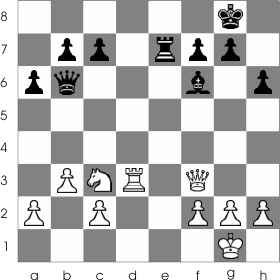 In the following game Black is down a rook. But if you look more closer you can see that White is predisposed to being checkmated on the back rank: 1... Re7:e1 2. Rc1:e1 Qb4:e1 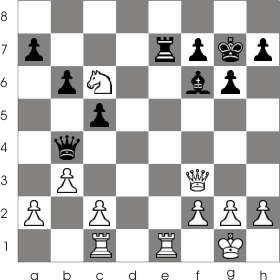 In the next example the black king has the escape square at h7 but that square is under the control of the white bishop from d3. So after 1. Re1-e8 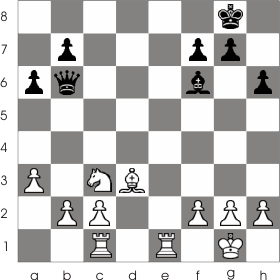 The fact is that many tactics revolves around back rank mate. Many beginners often fall in this kind of traps. |
 . Checkmate!