How to advance in chess
If you've read all the tutorials so far, then you are familiar with the rules of chess. So, you can setup the chess board and start moving the pieces. But, as you'll see, this game is not all about just moving the pieces around the board and capturing enemy pieces.
I've talked in the previous lessons about the three parts of the game: the opening, the middle game and the end game. I've said that what makes these parts different is the number of pieces and their positions. Because the number of pieces reduces during the game, the objectives of the game also changes.
In the opening each player concentrates on developing his position as faster and as harmoniously as possible while trying to stop his opponent developing his position.
In the middle game much of the action revolves around trying to control the center of the chess board, trying to exploit any weakness in the opponent's position and of course around protecting your own position.
The end game is characterized by a small number of pieces on the board. Because of the small number of pieces the result of the end game is sometimes more predictable than that of the middle game. In this part of the game sometimes even the smallest advantage could be exploited into helping you win the game.
In order to play chess at a more advanced level you will have to learn a little bit about the theory of the game. This way you will learn how to identify the main objectives of the game, you will be able to correctly evaluate the position of the pieces and their values. By understanding this you will know how and where to attack your opponent or how to defend your own positions.
A very important thing you need to know when playing a game is how to evaluate the distribution of forces on the chess board. That means that you have to understand who has a better situation : you or your opponent, so you can then know what to do next.
You already know that some pieces are more valuable than others and that their values depends on the number of pieces on the board and on their position. Because of this, their values will vary along the three parts of the game. I'll be talking about this in the next article.
There are a few criteria which you have to take under consideration when estimating the status of the game. Some of the most important are:
- Taking in account the pieces on the board (their number, strength and so on)
- The assessment on the mobility of each individual piece
- The safety of the king
You can determine the mobility of the pieces on the board by looking at their freedom of movement and at the pawn's structure. You can read more about how you can evaluate and play the game in the following articles.
Learn to capture
You've learned in the previous tutorial how to evaluate the strength of your pieces. You are going to see here some examples on how knowing the values of the pieces can help you in your game.
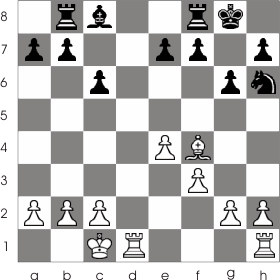
In the following example White has his turn to move. The white bishop at f4 is able to capture the black knight at h6 and the black rook at b8. But which one should he capture? The answer to that is very simple. As you know, a rook is more valuable than a knight or a bishop. That is why the best move in our case is to capture the rook : 1. B:b8
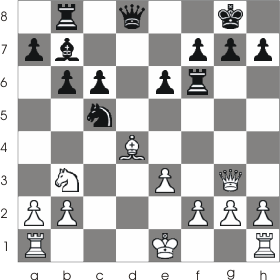
In the next example it's White's turn to move. You can see that he can capture the knight at c5 as well as the rook at f6with the bishop from d4. If he chooses to capture the knight than he will not accomplish much, he'll just exchange a bishop with a knight and pawn : 1. Bd4:Nc5 b6:c5 2. Nb3:c5 . But if he captures the rook he will gain a greater advantage; he will change a bishop with a rook (which is more valuable than the knight or the bishop) :1. Bd4:f6 Qd8:f6. That is why the second option it's better. You may have notes that White can also capture the rook at b8 with the queen. But that would be a very bad move as he would lose the queen for a rook.
 In the next game again it's White's turn to move. You can see that the knight at d5 is under considerable attack from the white pieces. But at the same time it is also protected by a relatively big number of black pieces. The question is : should White capture the knight? Let's see what happens if the black knight is captured:1.Nf4:d5 Nf6:d5 2. Nc3:d5 Bb7:d5 3. Bb3:d5 and Black can't go any further and capture the bishop from d5 with the queen without losing the queen. So, as you can see White had enough resources to perform that capture. As you probably observed the side that has more pieces controlling the square on which the capture will happen, will win. In this situations (when you have more resources than your opponent) you should start capturing using the less valuable pieces. For example, it's a bad idea if in the previous position White makes his first capture using the queen because Black would just capture the queen with the knight or the bishop and after that would just stop continuing capturing (so White exchanges the queen with a bishop... not the best thing to do...!).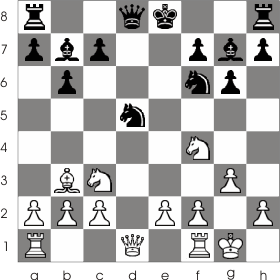
As a general rule you should avoid making captures if they don't bring you any advantage and you should make captures even if you gain a small advantage (Sometimes you only need an extra pawn to win a game).
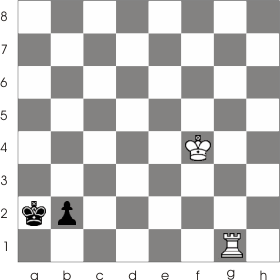
In the following game the black pawn is sustained by the king and is about to be promoted. That makes its value very big. White has no choice but to capture the pawn after it's promoted into a queen : 1... b2-b1 2. Rg1:b1 and the game ends in a draw. If the queen at b2 wouldn't have been captured then White would have lost the game (queen and king wins against rook and king)
Space in chess
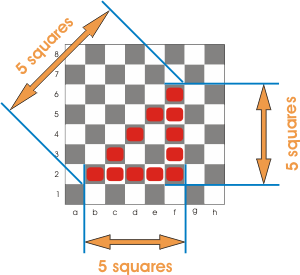
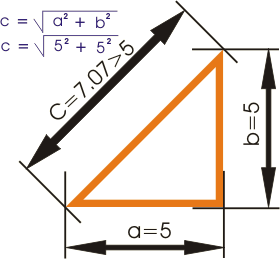
The space in chess (the chess board) is made up by the 64 squares on which the pieces move. As you may have noticed, this space is fragmented unlike the contiguous space from our world with which we are all familiarized . The fact that space in chess is fragmented gives it some special properties. Look at the images below. According to Pythagoras the length of c is greater than the length of a or b (this is in the normal space, which is contiguous). But in the fragmented space on the chess board all those distances are equal (that means that the distance on the lines and columns is equal to the distance on the diagonals) This is very important to know especially in pawns endings.
There is another important thing you should know. A piece has an absolute value (the ones we've talked about in the articles on which we presented each piece) and a relative value (given by the position of the piece on the board). The strength of a particular square is given by the number of the pieces that control that square and by their value and ,at the same time, by the pieces that occupy that square. At the same time the relative value of a piece is given by the position of the square it occupies. As you can see from the next images the range of action of a piece is larger when it occupies the center of the board and shrinks down if moved near the edge of the board. The only piece that doesn't follow this rule is the rook which's range of action is the same regardless of its position on the board.
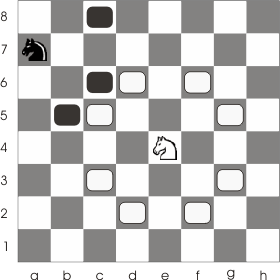
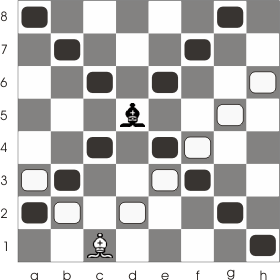
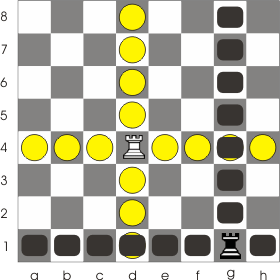
This is why the central squares are more valuable than those on the edge of the board and that is why most games have as their long term plan the objective of controlling the center.
Time in chess
Time is a fundamental element in chess. Pay attention that we are not talking about about the duration of the game nor the time allocated to each player to make his moves. That is the time which we all are used with (measured in hours, minutes, seconds, millenniums.. and so on..). The time we are talking about is a special kind of time whose measure unit is the move. That is why this time is determined by the succession of moves each player does. Notes that time, just like the space in chess, is fragmented (made up by more than one separated parts)
As you may guess there is a strong connection between the fundamental concepts of chess: the space, the pieces and the time. Each piece is moved to a particular square one time. In the battle that takes place on the chess board each side tries to develop its position as faster and as better as possible. This is usual done by trying to control as much as possible the center (as we saw in the previous article). From this point of view White has an advantage because he always makes the first move and, normally, he should always finish first developing his pieces and occupying the best squares. So, because of that first move, White has a big enough advantage which, in theory, should help him win the game. In reality, because of the great complexity of the game and the huge number of possible moves the advantage of the first move has only the value of an initiative. That initiative could, during the game, pass to Black if White makes a mistake.
There is this notion you will surely run into when studying different publications: the tempo.(Which is basically the time we've talked about until now). So, for further understanding of the concept of time ("tempo") proceed in reading the next article.
Tempo
Tempo is a term that originated from Italy. It means time (the chess time we talked about in the previous article). We will go more into detail on this notion in this article.
You may have run into this notion by now and, if you haven't, it's alright, you'll learn all you need to know about it in this article. When you'll find this term you will may find it in expressions like : "the move was made with tempo" or "the player lost a tempo" or something similar to that.
You should know that time in chess (tempo) can be won or lost . How is that, you may ask? Very simple! I said earlier, that in the beginning of the game both players try to develop their pieces as better and as faster as possible. If a player is forced to make a retreat of his piece than that means that he lost a tempo. Basically, if he moves a piece to a square and then he moves it back is like he never performed that particular move (so, he lost a move, a tempo; is like his opponent made two moves while he had made only one)
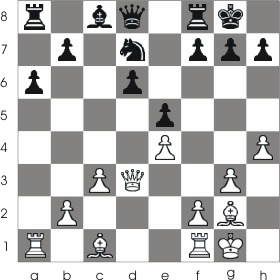
In the next game White attacks the black queen with 1. Bg5. But Black has a good response: 1... f6. Now the bishop must be taken to a safe location 2. Be3. You can see that the bishop could have been moved at e3 from the beginning. Now White had lost a tempo (it's like Black had made two moves while White made only one)
Common opening traps
You will see here a few examples of traps in the opening. They are the best argument that in chess, you always have to pay attention to what happens, otherwise you may lose the game when you least expect. You will see here that there are a great number of possibilities even at the beginning of the game.
I will only show you a limited number of this positions (only the most common).
